
From SaaS to self-built in weeks, not months: Why we created Audra Vibe
 Windmill Editorial Team6 min to read
How Windmill Digital replaced Jira and Tempo with a bespoke AI-native platform in a couple of weeks – and what that capability means for the companies we build for.
At Windmill Digital, we spend most of our time helping clients design and deliver software that fits the way they actually work. Recently, we turned that approach inward.
Why we moved away from Jira and Tempo
Like many teams, we relied on Jira for project management and Tempo for time tracking. They’re capable tools, and for a long time, they did the job – but over time, the friction became harder to ignore:
- Workflows that didn’t quite match how we operate
- Extra steps for simple tasks
- Limited flexibility without added complexity
- Increasing per-seat costs at each renewal
None of this was catastrophic. But it added up to a familiar problem: we were shaping how we worked around the tools, rather than the tools around us.
“Every time I walked past someone’s screen and saw them fighting a workflow to do something that should’ve been one click, that was money going out the door twice,” says Miles Hobart, Principal at Windmill Digital. “We were paying the licence and paying our people to work around it.”
So we asked a straightforward question: what would it look like to build exactly what we need?
Two weeks. One platform. Zero licences
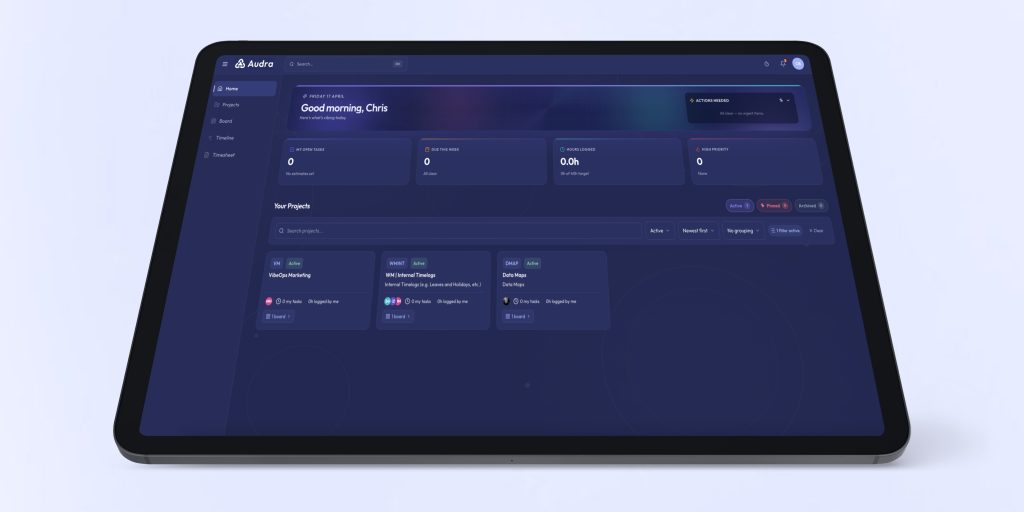
We gave the problem to Andrei Chiriaev, one of our senior developers. Two weeks later, Audra Vibe was live and the team was using it to manage real work.
That timeline wasn’t about cutting corners. It was about clarity:
- We spoke to the people actually using the system – project managers, consultants, finance
- We focused on what was genuinely painful, not what was theoretically possible
- We built only what we needed for a usable first version
“It wasn’t magic, it was just what building looks like now,” says Andrei. “I had AI pair-programming with me for the heavy lifting, a clear spec from the team, and a stack I’ve used a hundred times. The first couple of days was mostly listening. Two weeks later we were shipping.”
The result was a working internal platform that covered the core of our delivery process. V1 wasn’t perfect, it handled the majority of our needs and we’ve iterated quickly since. But it was immediately useful, and that’s what mattered.
What Vibe does (and why it works)
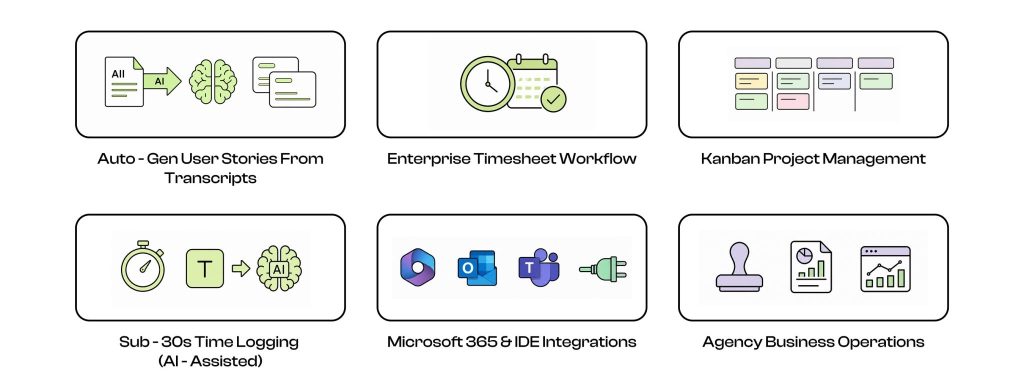
Rather than trying to replicate everything Jira and Tempo offer, we focused on outcomes. Vibe gives us:
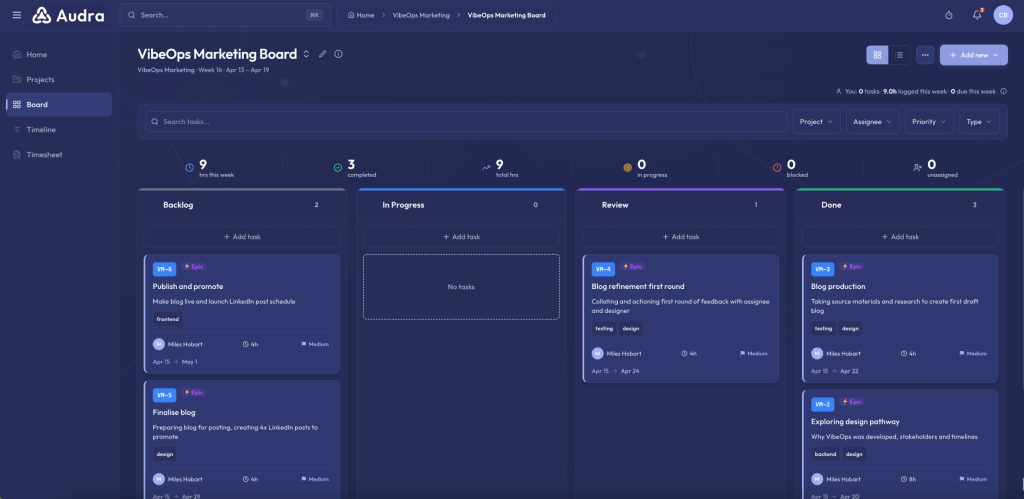
- A simple, flexible way to manage work across projects – full Kanban boards with drag-and-drop, WIP limits, bulk editing, and Jira-style shareable task links
- Fast, low-friction time tracking – sub-30-second logging via keyboard shortcut, floating timer, or AI suggestions drawn from your calendar and Git commits
- Clear approval workflows for finance and reporting – a draft-submit-approve-lock cycle with audit-grade rejection reasons
- Integrations with the tools we already use – Microsoft 365 SSO, calendar sync, Teams bot, plus an MCP endpoint so AI coding agents can create tasks and log time directly from the IDE
More importantly, it fits how we work. Tasks are quick to create and update. Time logging takes seconds, not minutes. Reporting reflects how we actually deliver projects, not how a generic system expects us to. And because we own it, we can change it whenever we need to.
The moment it clicked
A few weeks after rollout, one of our consultants asked: “Could we drop a meeting transcript into the system and have it generate user stories?”
In a typical SaaS setup, that’s a feature request, something you might get months or years down the line, if at all.
“I got the request on a Tuesday morning,” says Andrei. “By Wednesday afternoon, it was in production. The transcript goes in, the AI extracts decisions and action items, and Vibe creates a parent story with subtasks – pre-assigned, with estimates. Fourteen people on the team use it daily now. If we’d been on Jira, that would still be a post-it on someone’s wish list six months later.”
That wasn’t a roadmap discussion. It was a one-day turnaround. And that’s the real shift.
What’s changed
The biggest difference isn’t the feature set, it’s the speed of adaptation. When the system is yours:
- New ideas can be tested immediately
- Small inefficiencies can be removed quickly
- The platform evolves alongside the team, not behind it
“The thing people miss about vibe coding is that it isn’t lazy coding,” says Andrei. “What AI changes is the ratio of thinking-time to typing-time. The bottleneck used to be typing; now the bottleneck is clarity about what you want. That’s a much better place to be bottlenecked.”
We’re now on version 1.12.6 after a few weeks of steady iteration. Each change is driven by real usage, not assumptions.
Build vs. buy, revisited
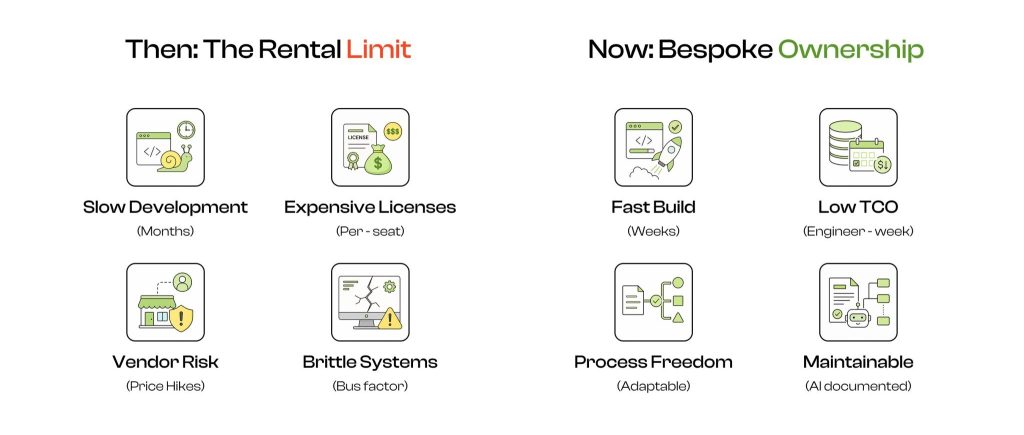
For a long time, the default answer in software was “buy unless you absolutely can’t.” That made sense when building internal tools was slow, expensive and risky. But that equation is shifting. With modern development approaches and AI-assisted workflows:
- Build times are dramatically shorter
- The cost of simple internal tools is often lower than annual SaaS licences
- Iteration is continuous, not tied to vendor roadmaps
Windmill isn’t alone in noticing this. Across the industry, organisations are beginning to question whether generic SaaS platforms are still the right answer for workflow-heavy, business-specific tools. Klarna walked away from Salesforce and Workday in late 2024, rebuilding internally with AI. Publicis Sapient has reported reducing its SaaS licences by roughly half. The UK’s National Cyber Security Centre recently wrote about a startup whose SaaS renewal quote doubled overnight, so one engineer vibe-coded a replacement in a couple of hours and it never renewed. In February 2026, investors caught up: software stocks lost hundreds of billions in value in days as the market repriced the risk. Analysts have started calling it “the SaaSpocalypse.”
That doesn’t mean SaaS is obsolete, it still makes sense in many contexts. But for business-specific tools where you’re paying a premium to work around the platform’s assumptions, the balance is changing fast.
What this means for our clients
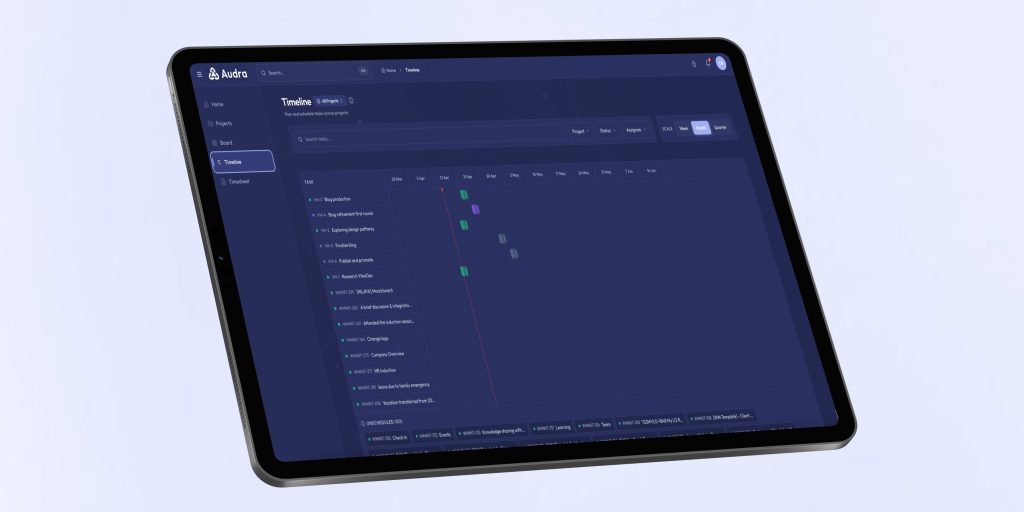
We didn’t build Vibe as a product. We built it to solve our own problem. What matters is what it demonstrates.
The same approach we used here – clear scoping, fast iteration and tight feedback loops – can be applied to:
- Internal systems that don’t quite fit your processes
- Tools that are expensive but underused
- Workflows that rely on too many disconnected platforms
“We’re having a lot of conversations at the moment with clients who are staring down their next SaaS renewal,” says Miles. “The question we ask them is simple: if you could have exactly the tool you wish you had – designed around how you actually work, for a comparable or lower cost – would you want it? The answer is usually yes. The part that used to stop the conversation was ‘but we can’t build it.’ That’s no longer true.”
Where we’re going next
Vibe is just one part of the Audra suite, a broader set of internal tools we’re developing, covering areas like DevOps automation (Forge) and AI system evaluation (Eval). Each piece is built the same way:
- Start with a real problem
- Build quickly
- Iterate based on use
Vibe is simply the first example we can share, because it’s already delivering value every day.
Want to see how this could apply to you?
If you’re approaching a renewal, or dealing with tools that don’t quite fit, it’s worth exploring what a tailored alternative might look like. We’re happy to talk it through, or show you Vibe in action.
Get in touch at hello@windmill.digital, or visit windmill.digital to learn more.
Two weeks was enough for us to prove the concept internally. The interesting question is what that kind of speed could unlock for your business.