
Making agentic AI real: How Windmill’s sprint bridges ambition and execution

Four weeks to a working prototype, architecture, and a path to scale that fits the business.

Making agentic AI real: How Windmill’s sprint bridges ambition and execution

The era of generative AI prototypes and pilot experiments is fading fast. Across industries, the real challenge now isn’t inspiration—it’s implementation. Organisations understand the promise of AI agents. What they need is a clear, structured path to turn that promise into scalable, reliable systems that deliver measurable impact.

That’s where Windmill’s Agentic AI Design Sprint comes in.

Designed specifically to help enterprises move beyond exploratory demos and into production-ready pipelines, the Sprint is a four-week, cross-functional engagement that delivers a working prototype, technical blueprint, and clear roadmap—all aligned to your actual business needs.

But what makes this sprint model different isn’t just the deliverables. It’s how tightly it’s aligned to what modern enterprises really need to make AI agents work at scale.

It Starts with Outcomes—Not Technology

Too often, AI projects begin with a solution looking for a problem. We reverse that.

Our sprint begins with stakeholder interviews, use case prioritization, and a deep dive into data availability and readiness. We use structured frameworks to identify which initiatives deliver high value with low friction—and deprioritize those that don’t. That means the energy goes into real opportunities, not hype-driven distractions.

We’re also experts at facilitation. Our team ensures rapid alignment across business, product, and technical stakeholders—cutting through complexity and surfacing clear priorities fast. And with deep UX design expertise, we bring the user perspective into the process from the very beginning—shaping agent experiences that are not only powerful, but intuitive, explainable, and fit for real-world use.

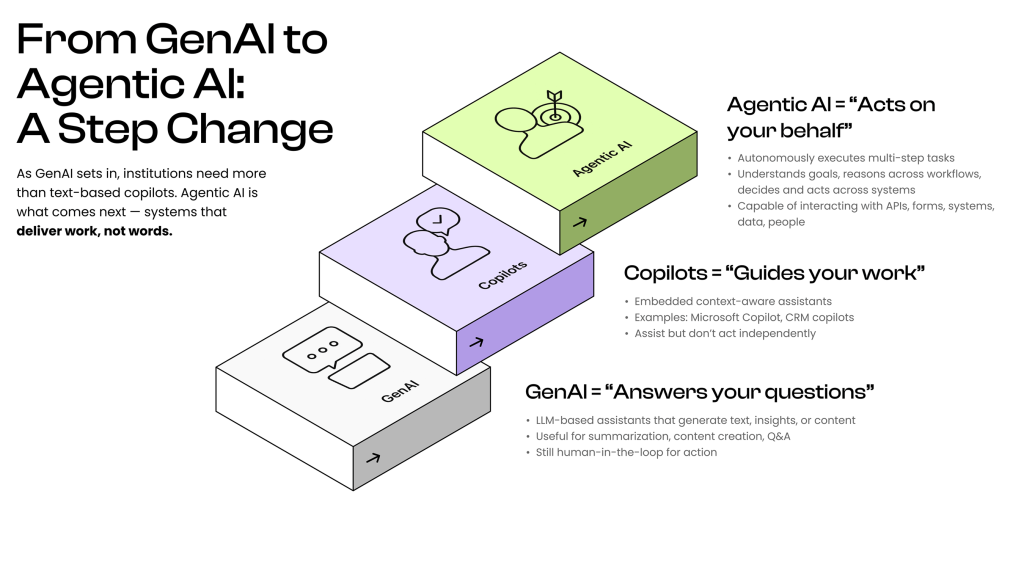
Diagram comparing GenAI, Copilots, and Agentic AI capabilities

We Redesign, Not Just Automate

Agentic systems aren’t just faster workflows. They’re fundamentally different ways of working. Instead of plugging AI into the gaps of legacy processes, we focus on redefining how work gets done—clarifying the roles of agents, what decisions they make, how they interact with users and data, and how they coordinate with each other.

Through our Agent Role Definitions and Pipeline Architecture, we lay out how autonomous components work together within your ecosystem—with a clear understanding of autonomy, supervision, memory, and orchestration.

We Build What Matters, Not What’s Generic

Off-the-shelf agents and generic copilots can streamline surface-level tasks—but they rarely shift the strategic dial. Real advantage comes from custom-built agents, designed to reflect how your organisation actually works: your workflows, your systems, your decision-making logic. These kinds of systems are difficult to replicate—and that’s exactly the point.

We typically develop these agents using open-source orchestration frameworks and toolchains, ensuring flexibility, transparency, and full control. But we also recognise that many enterprises have already committed to strategic AI platforms—so we design and implement within your approved technology stack, integrating with off-the-shelf agents, existing tools, APIs, and governance environments.

The result: a tailored, high-impact agentic system that’s both aligned with your internal architecture and built to solve real business problems—without vendor lock-in.

That’s why our Sprint focuses on vertical use cases—from onboarding and compliance automation to customer resolution and investment operations. These are complex, business-critical flows where AI becomes a proactive collaborator—adapting in real time, coordinating across tools, and delivering measurable outcomes.

This isn’t about deploying a chatbot. It’s about embedding intelligence deep into your operations, where it drives real value.

We Bake in Governance and Trust

Enterprises won’t scale AI unless they trust it. Our Sprint includes a Risk, Security & Governance Brief that addresses agent autonomy, data sensitivity, and safeguards. And we treat the user experience as central—not decorative.

We design interfaces and interactions that are explainable, predictable, and easy to understand. That’s how you build trust across teams—not just with performance, but with clarity and control.

AI implementation roadmap from evaluation to scaling across days, weeks, and months

It’s Modular. It’s Real. It’s Built to Scale.

The agent systems we design aren’t toy demos. They’re modular blueprints aligned with real-world systems and constraints—from API integrations and memory layers to tools and prompts. The architecture is designed to evolve, support multiple agents, and integrate seamlessly with existing stacks.

And it all culminates in a working proof of concept—not a slide deck or a speculative roadmap, but a functioning agentic pipeline that demonstrates value, capability, and a clear path to production.

Cross-Disciplinary by Default

You don’t get to scalable AI by throwing the problem over the wall. Our sprint is delivered by a core team of AI strategists, engineers, UX designers, and delivery leads, working as a single unit—but just as importantly, we work shoulder to shoulder with your cross-functional teams throughout the engagement.

That means business leads, domain experts, data leads, and architects are involved at every step—from defining goals to validating outputs. This close collaboration ensures that what we build is not only technically sound, but grounded in how your business actually operates. The result: systems that make sense, get adopted, and deliver value quickly.

Ready to Build Something Real?

If you’re looking to stop experimenting and start delivering, the Windmill Agentic AI Design Sprint is built to get you there. In a matter of weeks, we’ll take your AI ambition and turn it into a working prototype, a clear system blueprint, and a path to scale that fits your business—not a theoretical one.

Let’s create something transformational.

Next Steps

Ready to test this architecture on your data?

We validate use cases in 4 weeks via our productized Agentic AI Design Sprint.