
How the work is done
We do not design the interface, hand it to an AI team, and add controls at the end. Experience, intelligent behaviour and control are designed together, and evidence travels with the product from proof to production.
Five operating principles
Start with the human and operating decision
Define what the user or operator is trying to achieve, what the system may do autonomously, what must remain human, and what failure looks like - before choosing the model or the interaction.
Prototype behaviour and experience together
Test the interface and the intelligent behaviour as one product. Do not validate a polished journey against fake intelligence, or a strong model through a throwaway interface.
Vibe-to-Verify: define evidence before scale
Establish evaluation criteria, representative scenarios and business signals before a prototype becomes a production commitment.
Accountability by design
Human review, explanation, correction, escalation, permissions and audit trail are designed into the workflow and the operating interface where the use case requires them.
Keep knowledge and evidence continuous
Decisions, requirements, evaluation results and operating constraints stay connected as the product moves from discovery to build, and from release to iteration.
Frame → Prove → Build → Verify → Launch & Evolve
Every stage answers the same five questions. Control and evidence appear in the first stage, not the last - which is the whole of the claim above, and is checkable by reading down a column.
| Layer | Frame | Prove | Build | Verify | Launch & Evolve |
|---|---|---|---|---|---|
| Client decision | Which opportunity is worth investment, and what would make it work. | Whether the evidence supports building this. | What ships first, and what production readiness means here. | Whether this can be defended to the people who will ask. | What continues, at what cadence, and what triggers the next change. |
| Experience | The customer and operator outcome the product should create. | The workflow tested with the people who will use, supervise or operate it. | Intelligent behaviour made understandable and correctable inside the product. | Whether operators can actually review, correct and escalate in practice. | What real use reveals that testing did not. |
| Intelligence | What intelligent behaviour is useful, appropriate and technically feasible. | The important model, agent or system behaviour, on representative data. | Production system behaviour, data, orchestration and the integrations it needs. | Behaviour measured against the criteria set in Prove, not against a demo. | Drift, cost and quality tracked against the baseline rather than impressions. |
| Control | Where autonomy ends, what stays human, and what failure looks like. | How quality will be evaluated, and where human review or escalation is required. | Instrumentation, permissions, failure handling and the operator interface. | Audit evidence, oversight design and the record of what the system did and why. | Monitoring, regression checks and the oversight that keeps working after launch. |
| Evidence | A prioritised direction and an evidence plan the next stage can be judged against. | A working slice, a measured baseline, and the failure conditions that are now known. | Release criteria met, and the evaluation harness running against them. | Results a regulator, a risk function or a board can be shown. | A record that the product still does what it was signed off doing. |
Accelerators
Proprietary tooling is capability embedded in the method rather than software sold separately. Three categories support the work.
Discovery and lifecycle intelligence
Discovery capture, requirements and insight synthesis, decision documentation, continuity.
Keeps product and architecture knowledge from disappearing after the initial workshop.
- Audra Vibe - The delivery operating system behind the build work.
Evaluation and performance
Benchmark creation, regression testing, model and prompt comparison, quality measurement, cost and latency optimisation, drift detection.
Turns "it feels better" into repeatable evidence.
- Audra Eval - CI/CD quality gates for agentic AI.
Governance and monitoring
Policy controls, live monitoring, audit trail, risk flags, human-oversight evidence.
Makes accountability operable inside the product and the production system.
The full list of what Windmill does, by discipline, is on the capabilities page.
Products in production
Windmill operates its own software in production, not only consulting engagements. Three products are used in client delivery today.
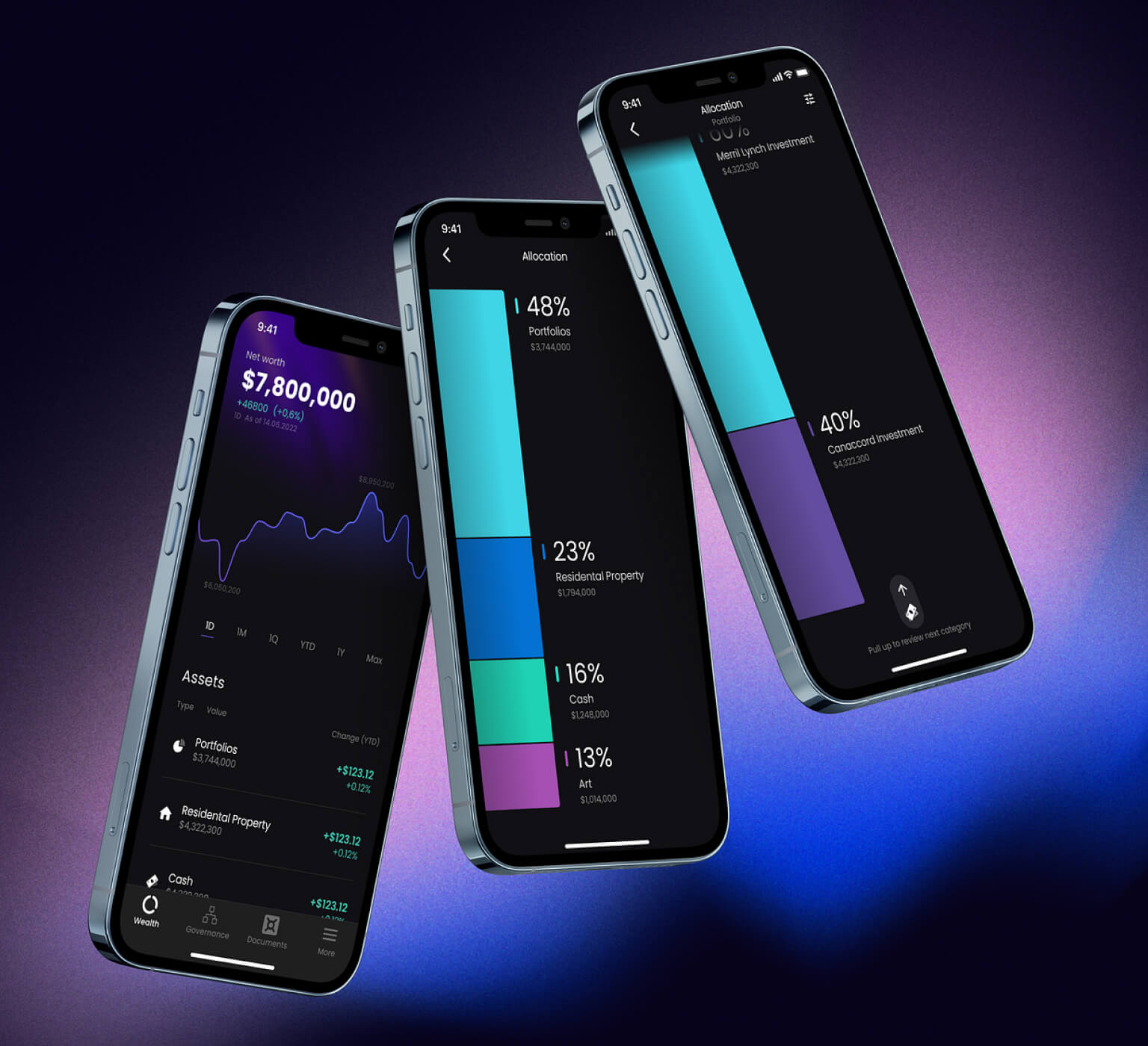
Topaz Modular Wealth Platform
White-labelled digital wealth management, in production for private banks and asset managers.
Topaz is a white-labelled digital wealth management suite for private banks, multi-family offices, external asset managers and trust providers. Branding, user journeys and integrations are customised while Swiss regulatory compliance is maintained.
- 360° wealth aggregation. Consolidated multi-custody portfolio reporting and asset allocation.
- Private client mobile. Native iOS and Android apps with biometric login and concierge messaging.
- Advisory and idea generation. AI-assisted investment proposal composer with regulatory bounds.
- Digital onboarding and KYC. Automated identity verification, source of funds and compliance questionnaires.
- Secure document vault. Encrypted statement delivery, digital signatures and audit logs.
- Core banking connectors. Synchronisation with Temenos, Avaloq and custom REST/FIX APIs.
Audra Eval
CI/CD quality gates for agentic AI.
Putting LLMs and agent networks into production requires continuous, automated evaluation. Audra Eval tests citation fidelity, hallucination rate, contextual accuracy and latency thresholds at every commit, and blocks any release that fails the agreed thresholds.
Audra Vibe
The delivery operating system behind the build work.
Audra Vibe is the AI-native software delivery operating system Windmill teams work in. It codifies agent design patterns, prompt repositories, evaluation suites and deployment scaffolds so a production system is reached in weeks rather than quarters.
Discuss the work in front of you
Tell us about the initiative, product or operating question you are working on.