
Chat-based offering analysis for private market investors
Investors interrogate offerings in natural language, with citations and compliance bounds.
Document-grounded product design and engineering
Built with 1PLTFRM, an affiliated Windmill venture in private markets.
This case describes historical implementation work, including a 2024 solution record. It does not report a current demo assessment or a measured accuracy or time-saving rate.

Private banking & wealth
UX, Agents
Windmill’s contribution
AI workflow work with 1PLTFRM
Windmill designed the question-answering experience and engineered the document-processing and retrieval workflow, including preparation of information held in tables and charts.
Visit 1PLTFRM →The workflow
01
Prepare text and visuals
Fund documents contain paragraphs, tables and charts. Graphical elements are annotated and converted into text for retrieval.
02
Index the fund material
The prepared content is vectorised and indexed so a question can retrieve relevant information from the documents.
03
Ask and inspect
Users choose a topic or type a question. The answer connects to the fund material so they can inspect its basis.
Context and objective
A chat surface over private-market offerings: retrieval, analysis agents, and a UI that never hides uncertainty.
The difficult information was not always in a paragraph
Private-fund material spans offering memoranda, fact sheets and presentations. Information an advisor needs can sit in a table or chart as well as in prose. The document-processing work had to account for those mixed layouts before the conversational interface could make them useful.
Make tables and charts retrievable
The 2024 solution record describes a Python tool for annotating graphical elements and GPT-4o for converting information from charts and tables into text. This preparation gave the team control over material that a plain-text extraction could miss. The resulting content could then enter the retrieval workflow alongside the document text.
Connect document preparation to the question
The prepared material was vectorised and indexed with FAISS, with the index stored in Azure Blob Storage. In the interface, users and advisors could select a suggested topic or type their own question. Retrieval connected the question to relevant fund material, and the answer experience gave users a way to inspect the supporting information.
Keep the implementation and its evaluation distinct
These records explain the processing and interface decisions. They do not establish a performance benchmark or verify today’s demo release. For another institution, evaluation needs to cover values and labels extracted from tables, answer support, document versions and access boundaries, using the documents and users actually in scope.
Applying this to your workflow
What to test for your institution
Can a user find the information they need and check the source behind the answer?
These are example evaluation scenarios for a new engagement. They are not reported test results from this case.
- Table extraction and answer support
- Ask about a fee in a table. Check the value, share-class label, conditions and supporting source together.
- Unanswered question
- Ask for information the material does not contain. Check that the system communicates the gap without inventing a value.
- Changed document
- Replace a fund document with a new version. Check which version the answer uses and whether the citation still supports it.
- Access boundary
- Test with users who have different document permissions. Check that an answer or citation does not reveal restricted material.
Evaluation & Assurance can establish representative tests and identify the changes needed for your next release. Product Build & Scale is available independently for implementation or integration.
Start with the engagement that matches the work in front of you.
Windmill can join at early direction, proof, production or evaluation of a live system. Existing work does not have to be restarted or replaced.
More Work
Related Case Studies
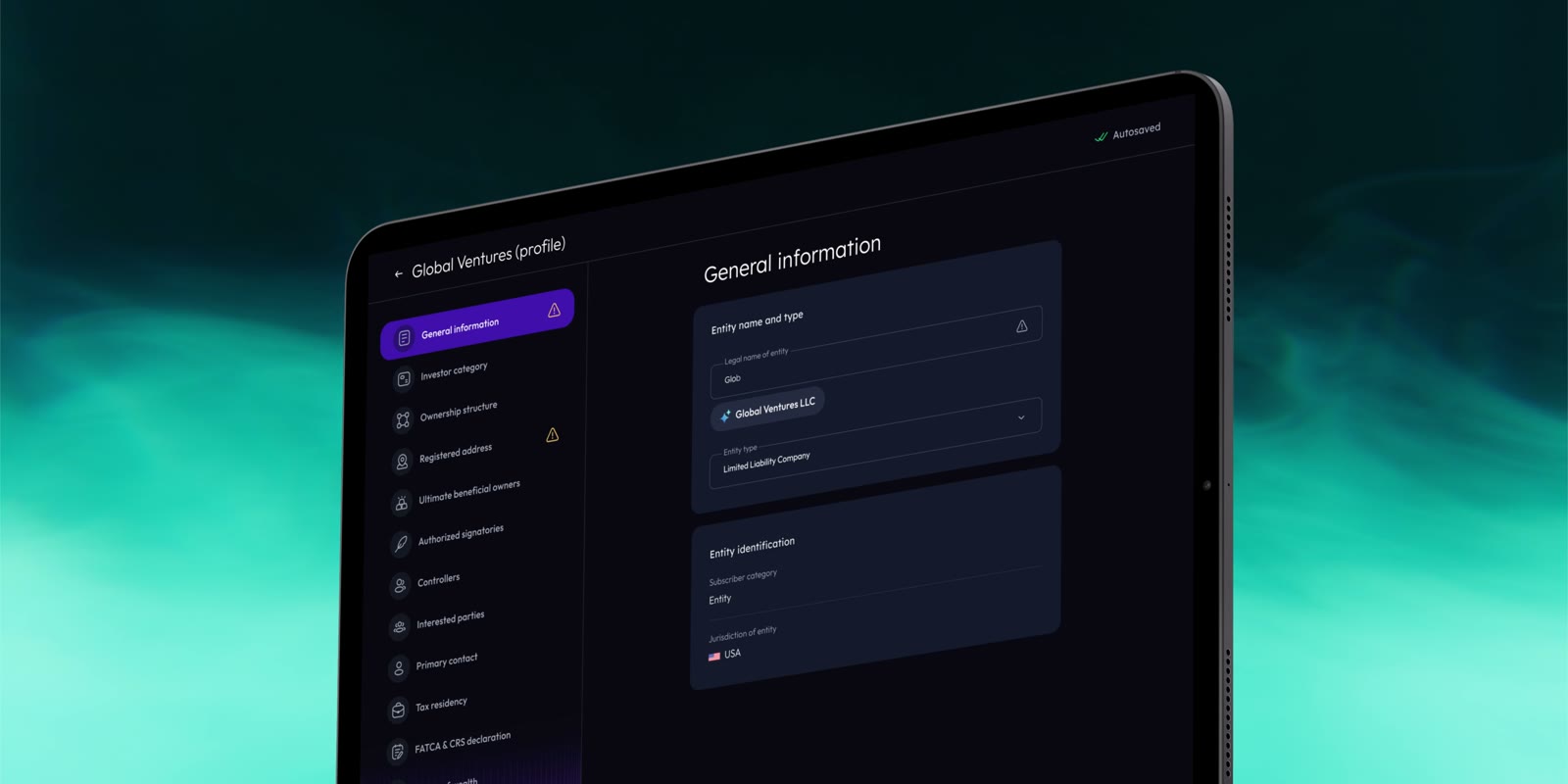
AI · Development
KYC/Onboarding re-imagined with AI agents
Agentic pipeline for KYC and onboarding - documents, checks, and explainable handoff.
AI · Development
Accelerating personalized health protocols with agentic AI
Modular agents parse clinical documents, assess risk, and compose protocols in under five minutes.